
Class 4 vs Class 5 uPVC Pressure Pipe: How to Specify the Right Rating
Class 4 and Class 5 uPVC pressure pipe differ in wall thickness and nominal pressure rating. Class 4 is rated to 10 Bar and Class 5 to 16 Bar at 20 °C. Class 4 suits gravity-fed and low-head distribution; Class 5 suits pumped mains, surge-prone lines and deep cover. Both are produced 50 to 315 mm.
Ask two engineers on the same Saudi site which class of uPVC watermain pipe a line needs and you can get two different answers. One will specify Class 5 across the whole network because it is safer. The other will specify Class 4 on the distribution legs because the static head never approaches 10 Bar. Both positions are defensible, and the gap between them is usually worth a material share of the pipe budget.
The choice is not a preference. It is an arithmetic result: what the line will actually see in service, plus a surge allowance, plus a temperature correction. This guide sets out how that number is arrived at, and where each class is the correct answer.
What the class number actually describes
For uPVC pressure pipe supplied to Saudi Standards, the class designation is a nominal pressure rating in Bar at 20 °C for water. Class 4 corresponds to PN 10, and Class 5 corresponds to PN 16. Both classes are made at the same outside diameters, so a 200 mm Class 4 and a 200 mm Class 5 pipe will fit the same fittings and the same trench, but the Class 5 pipe carries a thicker wall and a correspondingly smaller bore.
Three consequences follow from that, and they are the reason the decision matters:
- Material content. A thicker wall at the same outside diameter means more resin per metre. This is the direct cost difference between the two classes.
- Internal bore. The Class 5 pipe has a slightly smaller internal diameter, which marginally raises velocity and friction loss for a given flow. On long transmission runs this is worth checking rather than assuming.
- Pressure headroom. The Class 5 pipe absorbs transient events that would take a Class 4 line past its rating.
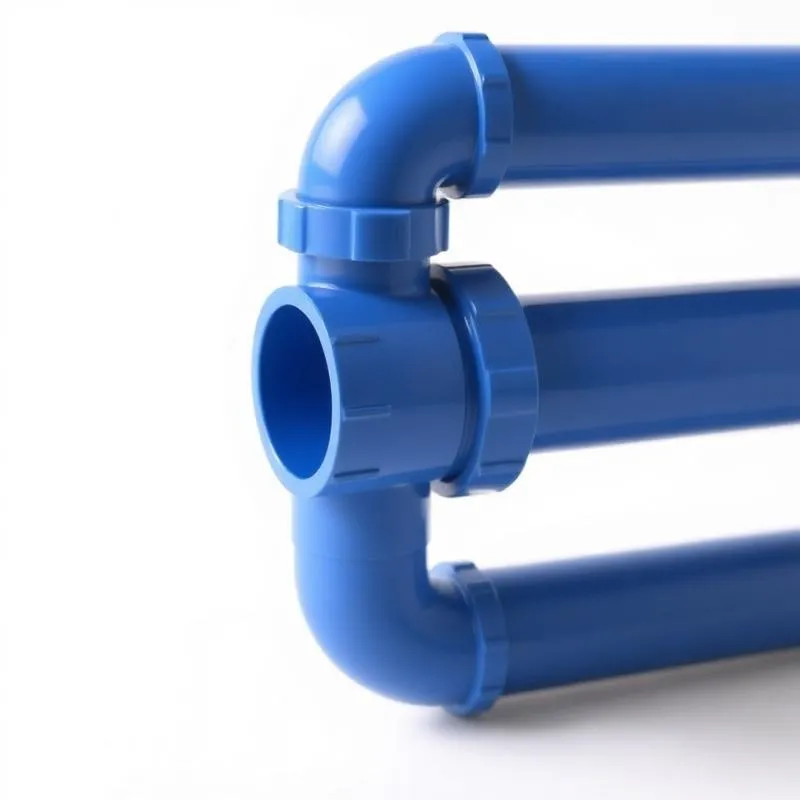
4B Factory produces uPVC watermain pressure pipe in both Class 4 and Class 5 across 50 to 315 mm, in blue, with a Loc-Ring integral socket and a dual compression seal rated against both positive and negative pressure. Full specifications sit on the watermain pressure pipes page.
The pressure budget: how the number is arrived at
Specifying by habit is what produces both failure and waste. The defensible method is to build a pressure budget for the line and then select the class that covers it. Four components go into that budget.
| Component | What it represents | Where the figure comes from |
|---|---|---|
| Static head | Pressure from elevation difference between source and lowest point on the line | Survey levels. Roughly 1 Bar per 10 m of vertical drop |
| Operating pressure | Pump discharge or supply-main pressure at normal duty | Hydraulic model, pump curve, or utility connection pressure |
| Surge allowance | Transient spike from valve closure, pump trip or pump start | Surge analysis where pumped; a design allowance where not modelled |
| Temperature derating | Reduction in allowable working pressure above 20 °C | Derating factor from the governing standard, applied to the class rating |
Pressure budget framework for uPVC watermain class selection. The sum of the first three components, checked against the class rating after the fourth is applied, is the specification test.
The last row is the one most often skipped on Saudi projects, and it is the one that matters most here. A class rating is quoted at 20 °C. Buried potable lines under adequate cover generally stay close to that. Surface-laid pipe, pipe in shallow cover, pipe in plant yards, and pipe carrying warm process or irrigation water do not. Where the sustained operating temperature is materially above 20 °C, the allowable working pressure falls below the class number and the derating factor from the governing standard must be applied before the class is selected. Confirm the applicable factor against the standard named in the project specification rather than a generic table.
The honest version of the argument
Class 5 everywhere is not a wrong answer. It is a conservative answer that trades money for certainty, and on a small network where the surge picture is unknown and no analysis is budgeted, that trade is often the right call. The case for Class 4 is only strong where the pressure budget has actually been calculated. If nobody has done the arithmetic, the conservative specification is the professional one.
Where Class 4 is the correct specification
Class 4 at 10 Bar covers a wide range of Saudi distribution work comfortably. It is typically the right selection where:
- The line is gravity-fed from a reservoir or elevated tank with a known and modest static head.
- It is a distribution leg downstream of a pressure-reducing valve, where the downstream pressure is controlled by design.
- The system is not pumped, or is pumped at low head with soft-start and slow-closing valves that limit transients.
- The line carries utility, landscape or irrigation water at low working pressure and is under adequate cover.
- The pressure budget, surge allowance included, lands with a clear margin below 10 Bar after derating.
On a municipal distribution network the majority of pipe by length often sits in this category, which is exactly why blanket Class 5 specification is expensive.
Where Class 5 is the correct specification
Class 5 at 16 Bar buys headroom, and there are conditions where that headroom is not optional:
- Pumped transmission mains. Pump trip generates a negative pressure wave followed by a positive return surge. The dual compression seal handles the negative phase; the class rating has to handle the positive one.
- Significant elevation change. Roughly every 10 m of vertical drop adds about 1 Bar of static head at the low point. A 60 m fall alone consumes 6 Bar before any pump pressure is counted.
- Rapid-acting valves. Fast-closing or automatic valves on a long run produce transients that a design allowance may understate.
- Deep cover or heavy traffic loading. Where external load is high, the thicker wall provides ring stiffness benefit alongside the pressure rating.
- Trunk mains and tender specifications. Where the specification names Class 5, it is named. Value engineering a stated pressure class downwards is not a substitute for a surge analysis.
Side-by-side decision matrix
| Decision factor | Class 4 (PN 10) | Class 5 (PN 16) |
|---|---|---|
| Nominal rating at 20 °C | 10 Bar | 16 Bar |
| Wall at equal outside diameter | Thinner | Thicker |
| Internal bore | Larger, lower friction loss | Slightly smaller |
| Resin content per metre | Lower, lower cost | Higher, higher cost |
| Gravity-fed distribution | Usually sufficient | Over-specified in most cases |
| Pumped transmission main | Only with surge analysis showing margin | Default selection |
| Elevation drop above roughly 50 m | Not recommended without analysis | Appropriate |
| Elevated service temperature | Derated margin erodes quickly | Retains usable margin after derating |
| Deep cover or traffic loading | Check ring stiffness separately | Additional wall benefit |
| Size range at 4B Factory | 50 to 315 mm | 50 to 315 mm |
Class 4 versus Class 5 uPVC pressure pipe selection matrix, prepared by 4B Factory for Saudi water distribution and transmission projects.
Mixing classes on one network
A network does not have to be a single class. Segmenting a line by pressure zone is standard transmission practice: Class 5 on the high-head segment near the pump or at the base of a fall, Class 4 on the segments downstream of pressure control where the budget allows it. Because both classes share outside diameters, the transition is a jointing and documentation exercise rather than a redesign.
Two disciplines make segmentation safe rather than risky:
- Mark the transition on the drawing and in the field. A class change that exists only in the bill of quantities will not survive a site substitution.
- Place the transition upstream of the pressure control, never at it. If a pressure-reducing valve fails open, the downstream Class 4 section sees upstream pressure. The transition point should sit where a control failure still leaves the lower-class pipe inside its rating, or the section should be uprated.
What to state when requesting a quotation
Class alone is not a complete specification. A quotation that can be priced and manufactured without a second round of questions carries all of the following:
- Nominal outside diameter and total length per size
- Pressure class, stated as Class 4 or Class 5
- Governing standard named in the project specification
- Joint type required, integral socket with seal or plain end
- Service: potable water, utility water, irrigation or process
- Fittings, bends and couplings required alongside the pipe
- Delivery location and any phased delivery dates
Where a run needs a bend, a repair coupling or a non-standard transition, those are made to order rather than bought in. See PVC fabricated products and customized fittings for what can be fabricated to a project drawing. For pressure applications specified to American standards rather than Saudi pressure classes, the equivalent decision is Schedule 40 against Schedule 80 on the ASTM PVC pipes range.
Where a specification requires the Saudi standard to be evidenced, current standard references are published by the Saudi Standards, Metrology and Quality Organization. Confirm the standard edition named in the project documents, as references are periodically revised.
Need the class confirmed against your line?
Send the diameters, lengths, static head and pump duty for your project and the 4B Factory technical team will confirm the class selection and quote factory-direct from Al-Kharj.
Request a Factory-Direct QuoteFrequently asked questions
Class 4 is rated to 10 Bar and Class 5 to 16 Bar for water at 20 °C. At the same outside diameter, Class 5 carries a thicker wall, a slightly smaller bore and more material per metre. Class 5 is selected where surge, static head or elevated temperature consume the Class 4 margin.
Yes, where the pressure budget supports it. Class 4 is widely used on gravity-fed and pressure-controlled distribution legs carrying potable water. The determining factor is working pressure plus surge allowance after temperature derating, not the water type itself.
Both classes are produced at the same outside diameters, so fittings sized on outside diameter are common to both. Confirm that any fitting or coupling is itself rated for the working pressure of the segment it sits in, since the pipe rating does not transfer to the fitting.
Yes. Segmenting a network by pressure zone is standard practice, with Class 5 on high-head segments and Class 4 downstream of pressure control. Mark every transition on the drawing and in the field, and position it so that a pressure-control failure still leaves the lower-class section within its rating.
Yes. Class ratings are quoted for water at 20 °C. Above that, the allowable working pressure falls and a derating factor from the governing standard must be applied before selecting a class. This matters most for surface-laid pipe, shallow cover, plant yards and warm process or irrigation water.
4B Factory produces uPVC watermain pressure pipe from 50 to 315 mm in both Class 4 and Class 5, in blue, with a Loc-Ring integral socket and a dual compression seal that resists both positive and negative pressure.
It is safe but not free. Class 5 carries more resin per metre, so blanket specification raises cost across the network. Where no surge analysis is available the conservative choice is defensible; where the pressure budget has been calculated, Class 4 on suitable segments removes cost without removing margin.