
uPVC Sewer Pipes Saudi Arabia
Sewer & Drain Pipes Manufacturer
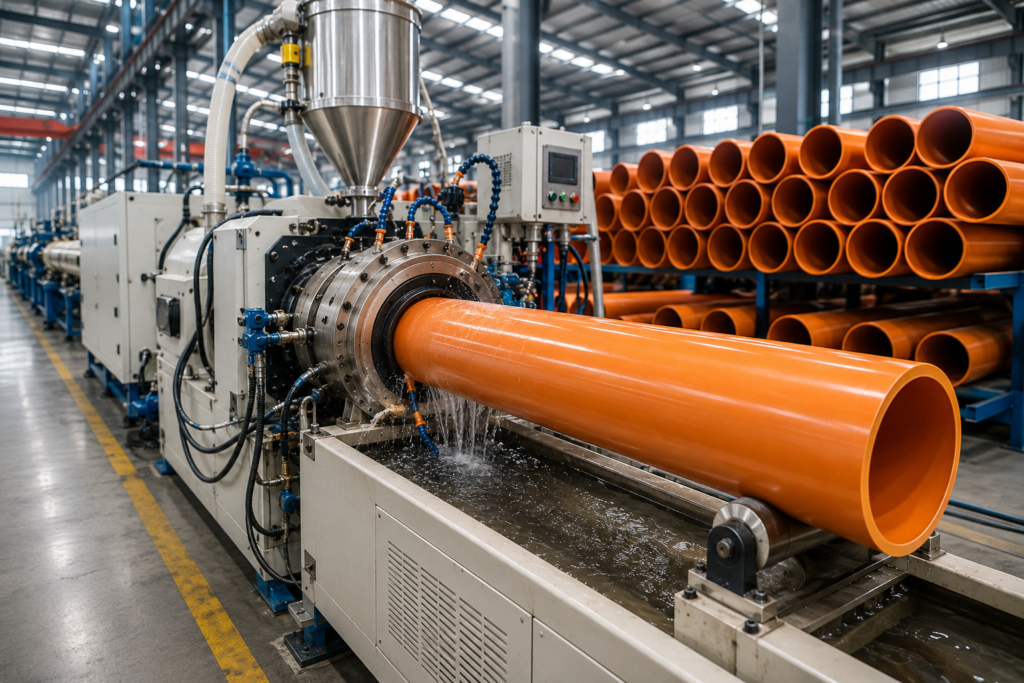
4B Factory manufactures uPVC sewer pipes Saudi Arabia contractors trust for heavy-duty municipal and industrial networks, produced from 110 mm to 710 mm at our Al-Kharj Industrial District facility. Built to Saudi Standards SAS 1395 and SAS 1396 in Class 2, 3, and 4, engineered for municipal sewerage, storm drainage, and industrial effluent networks across the Kingdom.
SAS Certified
SAS 1395 / 1396 Compliant
Up to 710 mm
Large-Diameter Capability
All Classes
Class 2, 3 & 4 In-House
Full Docs
NWC Submittal-Ready
KSA Delivery
Direct from Al-Kharj
Heavy-Duty uPVC Sewer Pipes Built for Saudi Infrastructure
Sewer and drain pipes carry waste water and storm water away from buildings, roads, and industrial sites, and they need to perform for decades under heavy traffic loads, aggressive sewage chemistry, and Saudi soil conditions. Concrete corrodes from H₂S attack. Metal corrodes from groundwater.
4B Factory uPVC sewer pipes are immune to corrosion, chemically resistant, and structurally stable for a 50+ year design life. The smooth internal bore delivers excellent flow with minimal blockage risk and lower hydraulic gradients than rough-walled alternatives.
Corrosion-immune
H₂S resistant
50+ year life
Smooth bore flow
Sizes, Classes, Lengths & Standards
Our uPVC sewer pipes are produced across the diameter range Saudi contractors and water authorities need, from residential drainage to major trunk sewers.
uPVC SEWER & DRAIN PIPES
SAS 1395 / SAS 1396 — Saudi Arabian Standard
| Standard | SAS 1395 / SAS 1396 |
| Diameter Range | 110 mm to 710 mm |
| Wall Classes | Class 2 (light), 3 (medium), 4 (heavy) |
| Standard Length | 6 metres (with integral socket) |
| Optional Lengths | 3 m, 9 m (to order) |
| Standard Colour | Terracotta |
| Jointing System | Solvent cement or rubber ring |
| Material | 100% virgin uPVC compound |
| Wall Type | Solid wall, smooth bore |
| Design Life | 50+ years buried |
| Manufacturing Origin | Al-Kharj, Saudi Arabia SA |
Available Sizes
Larger diameters or custom specifications can be produced for specific tender requirements. Contact our technical team with your project details.
SAS 1395 & SAS 1396 — uPVC Sewer Pipes Saudi Arabia
Saudi project tenders specify SAS 1395, SAS 1396, or both. Here’s the practical difference between them.
SAS 1395 — Above/Underground Building Drainage
Covers uPVC pipes for above-ground and underground non-pressure drainage within and immediately around buildings — soil and waste stacks, ground discharge, and compound drainage runs.
SAS 1396 — Underground Sewerage Networks
Covers uPVC pipes for buried sewerage and drainage networks — the trunk and branch infrastructure connecting buildings to municipal mains. The standard used by NWC and municipal authorities.
4B Factory sewer pipes comply with both standards depending on size and class. We supply test certificates, material declarations, and compliance documentation suitable for NWC submittal and consultant approval. For pressure-rated water networks, see our Watermain Pressure Pipes page.
Applications Across Saudi Arabia
Our sewer and drain pipes are installed across the Kingdom — from villa compound drainage to NWC trunk sewers.
NWC Sewerage Networks
National Water Company network expansions, municipal sewerage upgrades, and new district infrastructure.
Storm Drainage
Flash-flood mitigation drains in Riyadh, Jeddah, and Saudi cities; airport and highway storm systems.
Industrial Effluent
Wastewater lines for Jubail Industrial, Yanbu Industrial, Sudair, and 2nd Industrial City Riyadh.
High-Rise Drainage
Soil and waste stacks for commercial towers, hotels, hospitals, and large residential developments.
Residential Compounds
Gated communities, villa compounds, and apartment complex drainage and sewerage networks.
Vision 2030 Projects
Diriyah, Qiddiya, King Salman Park, and major Saudi mega-development drainage.
Agriculture & Farm
Qassim agricultural belt, Al-Kharj dairy operations, and irrigation return systems.
Highways & Infrastructure
Road sub-drainage, highway culvert connections, and municipal road drainage
Bulk Supply for Saudi Sewerage & Drainage Projects
4B Factory routinely supplies large quantities of uPVC sewer and drain pipes for major Saudi infrastructure programmes. If you’re tendering a project or running procurement, our team issues formal quotations with full compliance documentation, confirmed lead times, and project delivery scheduling.
Frequently Asked Questions for uPVC Sewer Pipes Saudi Arabia
Common questions from contractors, consultants, and procurement teams sourcing uPVC sewer pipes in Saudi Arabia.
SAS 1395 covers drainage within and around buildings. SAS 1396 covers buried sewerage and drainage networks. 4B Factory pipes comply with both depending on size and class.
Class 2 = light-duty shallow drainage. Class 3 = standard municipal sewerage. Class 4 = deep burial, heavy traffic loads, industrial. Your consultant specifies the class based on burial depth and load calculations.
We manufacture up to 710 mm in-house. For larger diameters, contact our technical team to discuss requirements.
Yes, manufactured to SAS 1395/1396 matching NWC technical requirements. We supply full submittal documentation with every project order.
Yes, for diameters 160 mm and above, rubber ring jointing is generally preferred. Both rubber ring and solvent cement joints are available.
uPVC is immune to H₂S attack (concrete is vulnerable), lighter (faster installation), smoother internally (better flow), and longer-lasting in Saudi conditions. uPVC is the modern engineering preference.
Yes. We sell directly to contractors, water authorities, and project teams. Send your bill of quantities for a formal project quotation.
Yes, bends (22.5°, 45°, 90°), junctions, reducers, end caps, and custom project fittings. See our Customized Fittings page for the full range.
Sourcing Sewer & Drain Pipes for Your Saudi Project?
Get factory-direct pricing, full SAS 1395/1396 compliance documentation, and large-diameter availability from the 4B Factory team. We supply contractors, municipalities, NWC project teams, and water authorities across the Kingdom.