
PVC Conduit Pipes Saudi Arabia
NEMA TC 2 Manufacturer in Al-Kharj
4B Factory manufactures NEMA TC 2 PVC conduit and duct from ½″ to 6″ at our Al-Kharj Industrial District facility — produced in both EPC-40 (normal-duty heavy wall) and EPC-80 (extra heavy wall) variants. Engineered for electrical, telecom, and underground utility networks across Saudi Arabia, with full SEC TMSS 01 alignment for direct burial and concrete-encased applications.
NEMA TC 2
EPC-40 & EPC-80
SEC-Aligned
TMSS 01 Compliant
KSA Delivery
Same/Next-Day Riyadh
½″ to 6″
Full MEP Size Range
Direct Burial
DB & EB Configurations
Saudi-Made PVC Conduit for Electrical, Telecom & Underground Utility Networks
PVC electrical conduit protects power and data cables from physical damage, moisture, and environmental exposure — above ground, in walls, under concrete slabs, and direct-buried in Saudi soils. Metal conduits corrode. uPVC doesn’t. PVC is also non-conductive, so a conduit cannot become live if cable insulation fails and the conduit itself needs no earthing. The cables still carry their own earth conductors.
4B Factory NEMA TC 2 conduits are rigid, non-metallic, and rated for 90 °C conductors — with superior weathering characteristics for Saudi sun exposure and full immunity to galvanic and electrochemical corrosion. Built for MEP contractors who need conduit that performs as long as the building stands.
90 °C conductor rated
Sunlight resistant
Above & below ground
Corrosion immune
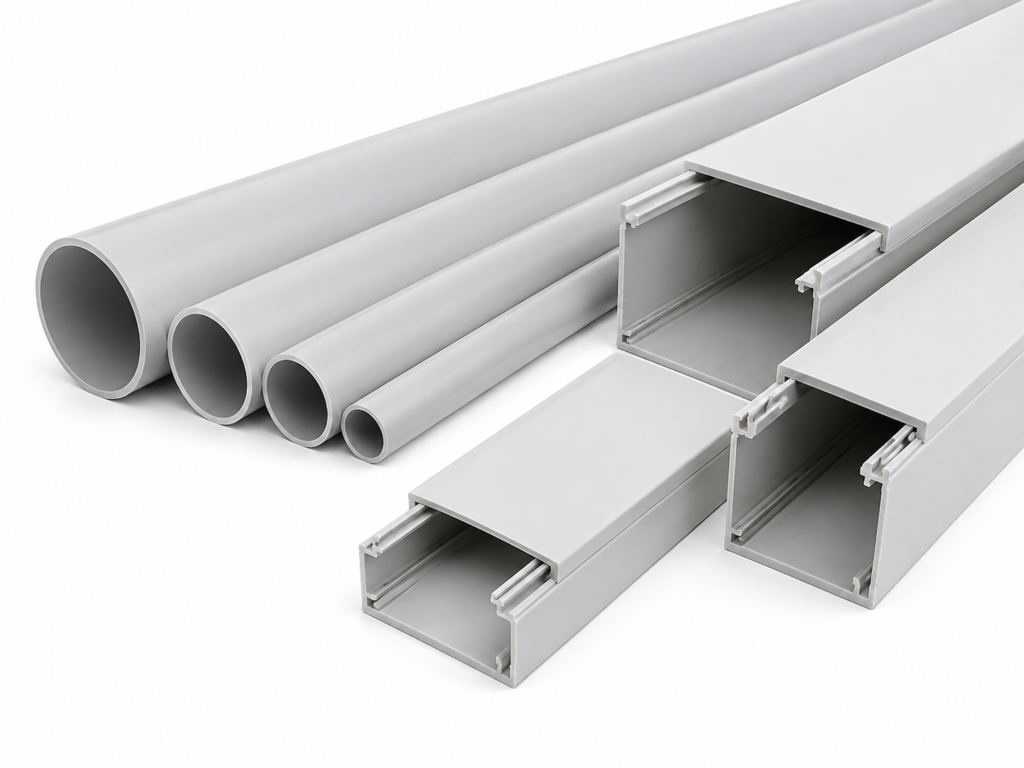
Sizes, Wall Schedules, Lengths & Standards
Our PVC conduit covers the schedule and diameter range Saudi MEP contractors, electrical consultants, and infrastructure project teams demand — from ½″ branch runs to 6″ trunk ducts.
PVC CONDUIT & DUCT
NEMA TC 2 — EPC-40 & EPC-80
| Standards | NEMA TC 2 (BI 50054), UL 651, SEC TMSS 01 |
| Conduit Types | EPC-40 (heavy wall), EPC-80 (extra heavy wall) |
| Diameter Range | ½″ to 6″ (15 mm to 150 mm) |
| Standard Length | 6 m (5.8 m and 4 m also available) |
| Standard Colour | Grey (Black available to order) |
| Jointing System | Belled (factory) socket — solvent cement |
| Material | Rigid PVC (single or multi-layer construction) |
| Conductor Rating | Suitable for 90 °C conductors |
| Burial Type | Direct burial (DB) and encased burial (EB) |
| Manufacturing Origin | Al-Kharj, Saudi Arabia SA |
Available Sizes
Custom lengths, colours, or special socket configurations produced to project specification. Send your tender requirements for a formal quotation .
EPC-40 vs EPC-80 — What They Mean
The numbers refer to wall thickness schedule. Higher number = thicker wall = better protection against physical damage. Match the type to your installation conditions.
EPC-40 — Normal-Duty Applications
Schedule 40 wall thickness electrical PVC conduit. Designed for normal-duty applications above ground, concrete-encased installations, or direct burial where the conduit is not exposed to physical damage. Used widely for in-wall and underslab MEP routing.
EPC-80 — Heavy-Duty / Physical Damage Areas
Schedule 80 wall thickness — the extra heavy wall variant. Required where the conduit may be subject to physical damage, per NEC 352.12(C). Suitable for exposed installations, vehicular impact areas, industrial sites, and demanding underground service.
Both EPC-40 and EPC-80 align with SEC TMSS 01 requirements for DB (direct burial) and EB (encased burial in concrete) applications. For Saudi telecom-specific uPVC duct to SAS 254/255, see our uPVC Duct Pipes page. For ASTM-spec pressure pipes, see PVC ASTM Standard Pipes.
EPC-40 and EPC-80 conduit sizes and cable fill
EPC-40 and EPC-80 conduit of the same trade size have the same outside diameter, so both take the same fittings and couplings. EPC-80 has a thicker wall, which leaves roughly 10% to 24% less space inside for cables. Check the fill table before switching a run from EPC-40 to EPC-80.
Outside diameter and minimum wall thickness
| Trade size | Metric designator | Outside diameter | EPC-40 min. wall | EPC-80 min. wall |
|---|---|---|---|---|
| ½″ | 16 | 21.3 mm (0.840″) | 2.77 mm (0.109″) | 3.73 mm (0.147″) |
| ¾″ | 21 | 26.7 mm (1.050″) | 2.87 mm (0.113″) | 3.91 mm (0.154″) |
| 1″ | 27 | 33.4 mm (1.315″) | 3.38 mm (0.133″) | 4.55 mm (0.179″) |
| 1¼″ | 35 | 42.2 mm (1.660″) | 3.56 mm (0.140″) | 4.85 mm (0.191″) |
| 1½″ | 41 | 48.3 mm (1.900″) | 3.68 mm (0.145″) | 5.08 mm (0.200″) |
| 2″ | 53 | 60.3 mm (2.375″) | 3.91 mm (0.154″) | 5.54 mm (0.218″) |
| 3″ | 78 | 88.9 mm (3.500″) | 5.49 mm (0.216″) | 7.62 mm (0.300″) |
| 4″ | 103 | 114.3 mm (4.500″) | 6.02 mm (0.237″) | 8.56 mm (0.337″) |
| 5″ | 129 | 141.3 mm (5.563″) | 6.55 mm (0.258″) | 9.53 mm (0.375″) |
| 6″ | 155 | 168.3 mm (6.625″) | 7.11 mm (0.280″) | 10.97 mm (0.432″) |
Dimensions follow the NEMA TC 2 schedule for rigid PVC conduit. Wall figures are minimums.
Cable fill: usable internal area
The National Electrical Code (NEC, NFPA 70) limits how much of a conduit's internal area cables may take up, so they can be pulled without damage and heat can escape. For three or more cables the limit is 40%. The table gives both the full internal area and the 40% figure for each size.
| Trade size | EPC-40 internal area | EPC-40 at 40% fill | EPC-80 internal area | EPC-80 at 40% fill |
|---|---|---|---|---|
| ½″ | 184 mm² | 74 mm² (0.114 in²) | 141 mm² | 56 mm² (0.087 in²) |
| ¾″ | 327 mm² | 131 mm² (0.203 in²) | 263 mm² | 105 mm² (0.164 in²) |
| 1″ | 535 mm² | 214 mm² (0.333 in²) | 445 mm² | 178 mm² (0.275 in²) |
| 1¼″ | 935 mm² | 374 mm² (0.581 in²) | 799 mm² | 320 mm² (0.495 in²) |
| 1½″ | 1,282 mm² | 513 mm² (0.794 in²) | 1,104 mm² | 442 mm² (0.684 in²) |
| 2″ | 2,124 mm² | 849 mm² (1.316 in²) | 1,855 mm² | 742 mm² (1.150 in²) |
| 3″ | 4,693 mm² | 1,877 mm² (2.907 in²) | 4,151 mm² | 1,660 mm² (2.577 in²) |
| 4″ | 8,091 mm² | 3,237 mm² (5.022 in²) | 7,268 mm² | 2,907 mm² (4.503 in²) |
| 5″ | 12,748 mm² | 5,099 mm² (7.904 in²) | 11,518 mm² | 4,607 mm² (7.142 in²) |
| 6″ | 18,433 mm² | 7,373 mm² (11.427 in²) | 16,513 mm² | 6,605 mm² (10.239 in²) |
Source: NFPA 70 (NEC) Chapter 9, Table 4, Article 352 rows for Schedule 40 and Schedule 80 PVC conduit.
How to size a conduit run
- Fill limits: 53% of the internal area for one cable, 31% for two cables, 40% for three or more (NEC Chapter 9, Table 1).
- Cable area: work out each cable's cross-section from its overall diameter on the cable maker's data sheet, including insulation and sheath (area = π × diameter² ÷ 4), then add them up.
- Bends: keep the total of all bends between pull points to 360° or less (NEC 352.26). Long runs with several bends may need a size up even when the fill figure passes.
Worked example: four cables, each 20 mm overall diameter. One cable is π × 20² ÷ 4 = 314 mm², so four take 1,257 mm². The conduit needs at least that much in the 40% column. A 2″ conduit (849 mm² in EPC-40) is too small. A 3″ conduit works in both EPC-40 (1,877 mm²) and EPC-80 (1,660 mm²).
SEC, telecom and consultant specifications can set stricter fill or spare-capacity rules than the NEC, so check the project specification first. For the standards that apply to pipe and duct in the Kingdom, see our guide to PVC pipe standards in Saudi Arabia. Send your cable schedule with your quote request and we'll price the matching sizes and schedule.
Applications Across Saudi Arabia
Our PVC conduit is installed across the Kingdom in projects of every scale — from villa electrical to industrial city power infrastructure.
MEP Building Electrical
In-wall, ceiling, and underslab conduit for commercial towers, hotels, hospitals, and education facilities.
SEC Underground Networks
Direct burial and concrete-encased conduit for SEC TMSS 01-spec distribution and feeder cables.
Telecom Underground Duct
STC, Mobily, and Zain underground cable management in residential and commercial developments.
Industrial Cable Management
Heavy-duty EPC-80 conduit for industrial plants, factories, and Modon-managed industrial cities.
Residential Compounds
Villa compound electrical routing, apartment block MEP, and gated community infrastructure.
Vision 2030 Projects
Diriyah, Qiddiya, King Salman Park, NEOM-adjacent power and data infrastructure.
Street Lighting & Signalling
Underground conduit for municipal lighting and traffic signal cable runs across Saudi cities.
Solar PV Installations
DC and AC conduit routing for utility-scale and commercial solar PV projects.
Bulk Supply for MEP, SEC & Telecom Project Tenders
4B Factory routinely supplies PVC conduit and duct for major Saudi MEP and infrastructure programmes. Our team issues formal tender quotations with full NEMA TC 2 / SEC TMSS 01 compliance documentation, material certificates, and project-scheduled delivery.
Frequently Asked Questions
Common questions from MEP contractors, electrical consultants, and procurement teams sourcing PVC conduit in Saudi Arabia.
EPC-40 is Schedule 40 wall thickness — for normal-duty above-ground, in-wall, or buried applications where there’s no physical damage risk. EPC-80 is Schedule 80 wall thickness (“extra heavy wall”) — required where the conduit is exposed to physical damage per NEC 352.12(C). Same outside diameter, thicker wall on EPC-80.
NEMA TC 2 is an American standard for rigid electrical PVC conduit (covered on this page). SAS 254/255 are Saudi standards for underground uPVC duct pipes (electrical and telecom). NEMA TC 2 covers above-ground, in-wall, and below-ground use; SAS duct is primarily for direct-burial underground. For underground-only specs, see our uPVC Duct Pipes page.
Yes. Our conduit aligns with SEC TMSS 01 specifications for both DB (direct burial) and EB (encased burial in concrete) applications. Compliance documentation supplied with every project order.
NEMA TC 2 conduit from ½″ to 6″ in EPC-40 and EPC-80. Larger sizes can be produced to order for specific project requirements.
Yes. Our PVC conduit is rated for above-ground use including outdoor exposure. The material has superior weathering characteristics, and conduit is rated for use with 90 °C conductors.
Grey is standard. Black is available to order for telecom or aesthetic requirements. Other colours can be produced for large project quantities.
Solvent cement jointing with a belled (factory-formed) socket at one end is the standard for NEMA TC 2 conduit. The belled end eliminates the need for a separate coupling and produces a stronger, leak-resistant joint.
Yes — standard and special-radius elbows, couplings, adapters, and junction fittings. Note: NEMA TC 2 itself doesn’t fully address elbows/fittings, but our team supplies UL-listed companion fittings or custom-manufactured options. See our Customized Fittings page.
Need NEMA TC 2 Conduit for Your Saudi Project?
Get factory-direct pricing, full NEMA TC 2 / SEC TMSS 01 compliance documentation, and Saudi-manufactured electrical conduit from the 4B Factory team. We supply MEP contractors, electrical consultants, SEC project teams, and telecom subcontractors across the Kingdom.
Guides for conduit buyers
- conduit vs duct selection guideChoosing cable protection by standard, such as NEMA TC 2.
- D56 duct pipe specificationA small-bore uPVC duct made to a British Standard.