
How to Choose Perforated and Slotted uPVC Pipe in Saudi Arabia
Choosing perforated or slotted uPVC pipe comes down to four decisions: the opening type (round holes or narrow slots), the pipe diameter, the hole spacing, and how the openings are oriented once the pipe is in the trench. Get those four right for your soil and water table and the drain works for decades. Get them wrong and it clogs, collapses, or lets fines wash in.
Perforated and slotted uPVC pipes do the same core job in Saudi projects: they let groundwater enter (or leave) the pipe wall while the pipe carries it away. You will find them under road subgrades, beneath landscaped areas, in agricultural field drainage, as well screens in water extraction, and in landfill leachate collection. The trouble is that most catalogue patterns are generic, and a pattern that suits a sandy Riyadh subsoil is wrong for a silty coastal site near Jeddah. This guide walks through each decision the way our production team weighs it before a run leaves the Al-Kharj plant.
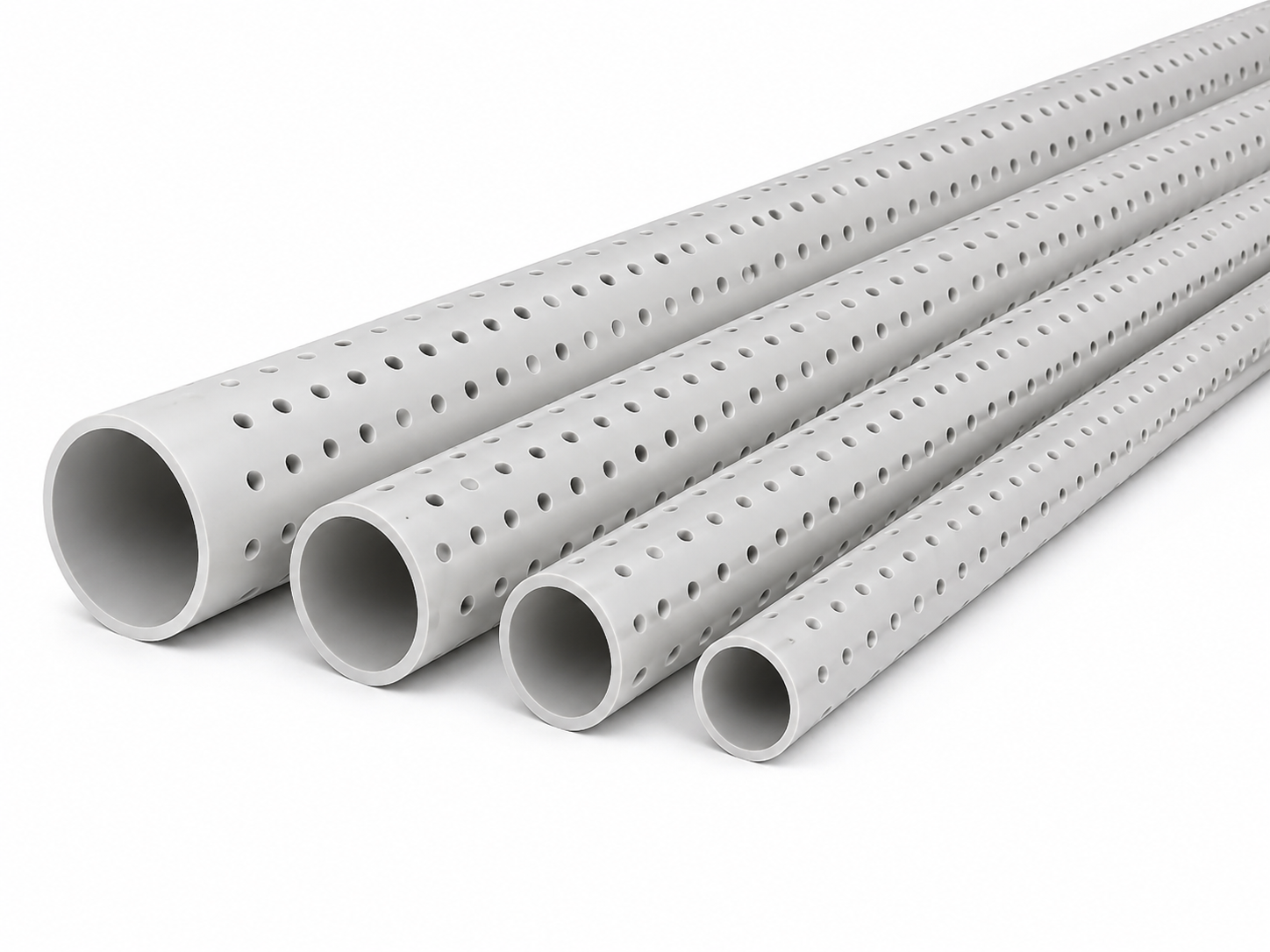
What are the key differences between slotted and perforated pipe?
Perforated pipe has round drilled holes; slotted pipe has narrow linear cuts across the pipe wall. Perforated pipe gives a higher open area and takes in water fast, which suits clean granular soils and general sub-soil drainage. Slotted pipe uses fine openings, often 0.3 mm to 3 mm wide, that hold back finer soil particles, which makes it the safer choice for silty or sandy ground and for well screens where sand ingress ruins a pump.
The practical way to decide is to match the opening to the soil, not to a default. If the surrounding material is coarse gravel or a designed graded filter surrounds the pipe, round perforations move the most water. If the native soil is fine and there is no filter sock or gravel envelope, slots (or perforations with a geotextile wrap) stop the drain silting up from the inside.
| Factor | Perforated (round holes) | Slotted (linear cuts) |
|---|---|---|
| Opening shape | Circular drilled holes, 5 to 13 mm typical | Narrow slots, sub-millimetre to a few mm wide |
| Open area / intake | Higher, faster water entry | Lower, more controlled entry |
| Fines control | Needs gravel envelope or geotextile in fine soil | Holds back fine particles on its own |
| Best fit | Sub-soil land drainage, road drains, coarse soil | Well screens, silty ground, sand-prone sites |
| Typical KSA use | Landscape and infrastructure drainage | Water wells, dewatering, filtration |
Rule of thumb: coarse soil or a graded gravel filter, go perforated for maximum flow. Fine or variable soil with no filter, go slotted (or perforated wrapped in geotextile) to keep the fines out.
What size perforated pipe should you use?
Perforated pipe size is set by the flow it must carry, not by habit. For sub-soil and landscape drainage, 75 mm to 160 mm handles most residential and light infrastructure runs. Larger collector drains, road schemes, and agricultural mains move up to 200 mm, 315 mm, and beyond, while well screens and leachate collectors are sized to the borehole or the cell. At 4B Factory we produce perforated and slotted uPVC from 75 mm up to 500 mm, so the pipe is matched to the hydraulic load rather than forcing the job to fit a stock diameter.
Three things drive the choice of diameter on a Saudi site:
- Peak flow. Estimate the volume the drain must remove at its worst (a storm event, a high water table, an irrigation cycle) and size the pipe so it never runs full under that load.
- Gradient and length. A long, shallow run needs a larger bore than a short, steep one to move the same water without backing up.
- Access and cover. Deeper trenches and heavier surface loads (under a road versus under a lawn) push you toward a heavier wall and often a larger diameter for structural margin.
| Application | Typical diameter | Notes |
|---|---|---|
| Landscape and garden drainage | 75 to 110 mm | Short runs, light flow |
| Road and infrastructure sub-drains | 110 to 200 mm | Continuous collector lines |
| Agricultural field drainage | 110 to 250 mm | Laterals into a larger main |
| Water well screens | Sized to borehole | Slotted, matched to gravel pack |
| Landfill leachate / large collectors | 315 to 500 mm | High volume, structural cover |
If you are unsure, share the flow, the trench depth, and the soil with the factory and we will recommend a diameter and wall rather than guess. That short conversation prevents an undersized drain that floods or an oversized one that wastes budget.
What is the standard hole spacing for perforated pipes?
There is no single universal spacing; it is set by the pattern the drain needs, typically expressed as longitudinal pitch and number of rows. 4B Factory manufactures to a longitudinal pitch of 30 mm to 200 mm, with 1 to 6 rows of perforation and an angular pitch of 40, 80, or 120 degrees for two-row geometry. Closer spacing and more rows raise the intake area for high-flow or high-water-table sites; wider spacing and fewer rows suit lighter drainage and keep the pipe stronger where cover loads are heavy.
Well screens are the exception that proves the rule. There the open area is designed against the aquifer and the gravel pack, so the slot or hole pattern is calculated, not taken from a catalogue. This is why we treat spacing as a project variable. A generic pattern rarely matches site hydraulics or filter design, and an over-perforated pipe under a road can lose the wall strength it needs.
| Pattern parameter | 4B Factory range | What it controls |
|---|---|---|
| Hole diameter | 5 mm to 13 mm | Intake speed and fines size held back |
| Longitudinal pitch (LP) | 30 mm to 200 mm | Spacing of holes along the pipe |
| Number of rows | 1 to 6 | Total open area around the pipe |
| Angular pitch | 40°, 80°, 120° | How rows sit around the circumference |
| Pattern type | Straight or staggered | Even intake versus concentrated intake |
Need a pattern matched to your site?
Send us your soil type, water table, flow, and diameter. We fabricate the perforation to your specification at our Al-Kharj plant and deliver across the Kingdom.
Request a Free QuoteDo perforated PVC pipe holes point up or down?
It depends on the job. To drain water out of the ground, the holes usually point down; to disperse water into the ground, they point up. For sub-soil and land drainage, where the goal is to collect groundwater and carry it away, the perforations are laid facing down so water rising in the surrounding soil enters at the lowest point and the pipe fills from the bottom. This keeps the line collecting even when the water table is low and reduces the chance of fine sediment settling over the openings.
The picture flips for dispersal. In a soakaway, a septic leach field, or any system meant to release water into the soil, the holes commonly face up (or up and to the sides) so liquid spreads out and percolates rather than short-circuiting straight down. Well screens are again their own case: the slots run around the full circumference because water enters from every direction in the aquifer.
On site: mark the invert before backfilling so the crew orients the pipe correctly, and protect perforated collector drains with a gravel envelope or geotextile so the openings stay clear over the life of the drain.
Bringing the four decisions together
A sound specification reads across all four at once. A road sub-drain in coarse Riyadh subsoil might be 160 mm perforated pipe, staggered pattern, holes down, wrapped in geotextile. A dewatering well on a silty coastal site might be slotted pipe sized to the borehole, slots around the full circumference, inside a graded gravel pack. Same product family, very different builds, because the soil and the purpose changed.
That is the case for fabricating to specification rather than buying a fixed catalogue pattern. When the hole diameter, row count, pitch, and orientation are chosen for your ground, the drain does its job for the life of the asset. To see the full size and pattern range we produce, view our perforated uPVC pipes page. For gravity drainage lines that carry the collected water onward, our uPVC sewer and drain pipes pair with these systems, and pressure runs use our watermain pressure pipes.
Frequently asked questions
Perforated pipe has round drilled holes with a higher open area, ideal for coarse soils and general sub-soil drainage. Slotted pipe uses narrow linear cuts that hold back fine particles, making it better for silty ground and for well screens where sand ingress must be prevented. Match the opening to the soil rather than defaulting to one type.
Size is set by the flow the drain must carry. For landscape and light drainage, 75 to 110 mm is common; road and infrastructure sub-drains use 110 to 200 mm; large collectors and leachate lines reach 315 to 500 mm. 4B Factory produces perforated and slotted uPVC from 75 mm to 500 mm so the pipe matches the hydraulic load.
There is no single universal spacing; it is set by the drainage need. 4B Factory fabricates to a longitudinal pitch of 30 mm to 200 mm, with 1 to 6 rows and an angular pitch of 40, 80, or 120 degrees. Closer spacing raises intake for high-flow sites, while wider spacing keeps the pipe stronger under heavy cover.
To drain water out of the ground, the holes usually point down so groundwater enters at the lowest point. To disperse water into the ground, as in a soakaway or leach field, the holes point up so liquid percolates outward. Well screens are slotted around the full circumference because water enters from every direction.