PVC Pipe Fittings Guide: Types, Names, Standards & How to Choose in Saudi Arabia
Every PVC pipeline is only as reliable as the fittings that join it. This guide explains the main types of PVC and uPVC pipe fittings, what each one does, the Saudi and international standards that govern them, and how to choose and join the right fitting for water, drainage, conduit and industrial systems across the Kingdom.
PVC pipe fittings are the connectors that join, redirect, branch, resize or seal pipe runs. The core types are elbows (change direction), tees and crosses (branch the line), couplings and unions (join two pipes), reducers and bushings (change diameter), adapters (change end type), and caps and plugs (seal the end). In Saudi Arabia, pressure and industrial fittings follow ASTM D2466 and D2467, while sewer, drainage and duct fittings align with Saudi Standards such as SAS 1395/1396 and SAS 254. Choosing the right fitting means matching the material grade, size, pressure class and jointing method to the application and confirming the standard the project specifies.
What Are PVC Pipe Fittings?
PVC pipe fittings are moulded or fabricated components that connect lengths of pipe and control the geometry of a pipeline. They change direction, split or combine flow, join pipes of the same or different diameters, adapt between threaded and socketed ends, and close off a run. Without fittings a pipe is just a straight tube; the fittings are what turn it into a working water, drainage or cable-protection network.
Fittings are produced from the same base polymer as the pipe. PVC (polyvinyl chloride) is the general family, while uPVC (unplasticised PVC) is the rigid, high-strength grade used for pressure and buried applications. Because the fitting and the pipe share a material, a correctly jointed connection behaves as one continuous, corrosion-free component, which is a large part of why PVC systems last for decades in Saudi Arabia's demanding climate. For the wider material comparison, see our guide to uPVC vs PVC pipes.
The Main Types of PVC Pipe Fittings
Fittings are grouped by the job they do inside the system. The table below is the fast reference; the sections underneath explain how each family is used on real Saudi projects.
| Fitting Family | Function | Common Variants |
|---|---|---|
| Elbows & Bends | Change the direction of the run | 90° elbow, 45° elbow, long-radius sweep bend, street elbow |
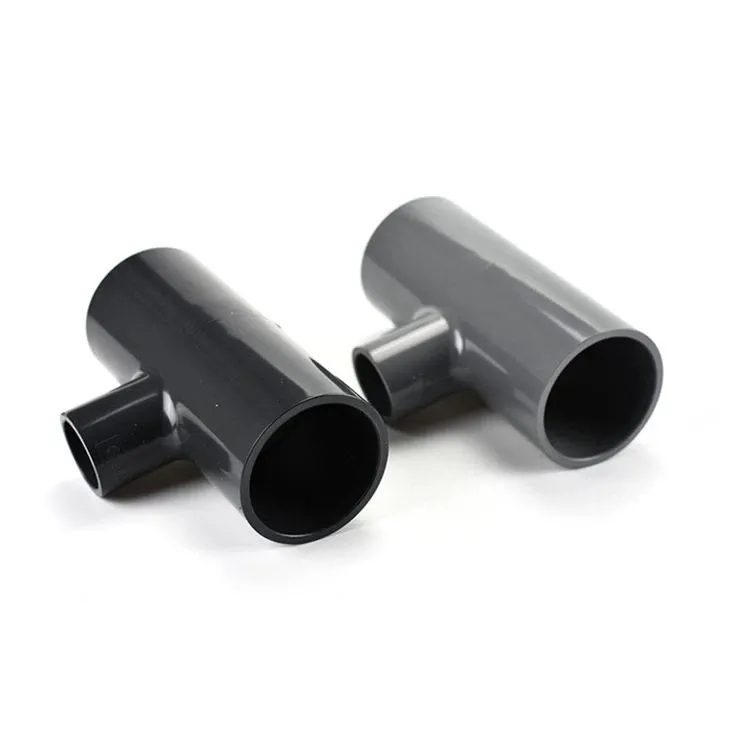
| Tees & Crosses | Branch or combine flow | Equal tee, reducing tee, sanitary tee, cross |
| Couplings & Unions | Join two pipes in line | Socket coupling, repair coupling, register coupling, union |
| Reducers & Bushings | Transition between diameters | Reducing coupling, concentric/eccentric reducer, bushing |
| Adapters | Change the end type (thread ↔ socket) | Male adapter, female adapter, flanged socket |
| Caps & Plugs | Seal the end of a pipe or fitting | End cap, threaded plug, bell end |
| Flanges | Bolted, demountable joint | Slip-on flange, blind flange, flanged socket |
Core PVC/uPVC pipe fitting families and their functions. Custom-fabricated variants are available for project-specific geometry.
Elbows and Bends
An elbow changes the direction of a pipe run. The 90-degree elbow makes a sharp corner around walls, columns or trench turns, while the 45-degree elbow gives a gentler change of angle that lowers friction loss. For drainage and sewer lines a long-radius sweep bend is preferred over a sharp elbow because its gradual curve keeps solids moving and reduces the risk of blockages. A street elbow, with one socket and one spigot end, connects directly into another fitting without an intermediate offcut of pipe.
Tees and Crosses
A tee branches one line into two, or combines two lines into one, at a 90-degree junction. An equal tee keeps all three openings the same size; a reducing tee takes a smaller branch off a larger main, which is the everyday fitting for tapping a distribution line. In drainage, a sanitary tee uses a swept entry so waste enters the main flow smoothly. A cross joins four pipes at a single point and is used where two lines intersect or where a framework needs extra rigidity.
Couplings and Unions
A coupling is the simplest fitting: a short socket that joins two pipes of the same diameter end to end. A repair coupling is longer and slides freely, letting a technician bridge a cut or damaged section without dismantling the whole run, which makes it invaluable for maintenance on live networks. A register coupling has an internal stop that centres both pipe ends. A union does the same joining job but unscrews into three parts, so a section can be removed for servicing without cutting.
Reducers, Bushings and Adapters
These fittings manage size and end-type transitions. A reducer connects a larger pipe to a smaller one; a concentric reducer keeps the centreline aligned, while an eccentric reducer keeps one edge flat to avoid trapping air in horizontal runs. A bushing reduces the opening of an existing fitting to accept a smaller pipe. An adapter changes the end type, converting a socket to a thread so PVC can meet metal fittings, valves or equipment. On large-diameter pressure lines, a flanged socket provides a bolted, demountable connection.
Caps, Plugs and End Fittings
A cap fits over the outside of a pipe end to seal it; a plug fits inside the socket of a fitting. Both terminate a run permanently or temporarily, whether for pressure testing, future expansion or an isolated section during maintenance. A bell end is a widened socket formed on the pipe to receive the next length without a separate coupling.
The two mistakes we see most on Saudi sites are mixing pressure and non-pressure fittings, and forcing a solvent-cement fitting onto a pipe cut with a burr left on the edge. Pressure fittings carry a thicker wall for a reason, and a clean, chamfered pipe end is what lets the socket seat fully. Both are avoidable at specification stage, and both are cheaper to get right than to dig up later.
Standards for PVC Pipe Fittings in Saudi Arabia
On any Saudi project of scale, the fitting is only acceptable if it carries the standard the specification calls for. This is the layer most supplier pages leave out, yet it is the layer that decides whether your consignment passes approval.
| Standard | Governs | Typical Use |
|---|---|---|
| ASTM D2466 | Schedule 40 PVC socket fittings | General pressure & industrial systems |
| ASTM D2467 | Schedule 80 PVC socket fittings | Higher-pressure & heavy industrial lines |
| SAS 1395 / 1396 | uPVC sewer & drainage systems | Gravity drainage & wastewater fittings |
| SAS 254 | uPVC electrical & telecom duct | Conduit couplers, bends & adaptors |
| DIN 8061 / 8062 | uPVC pressure pipe & fitting dimensions | Pressure-class fittings (metric) |
Standards commonly specified for PVC/uPVC fittings on Saudi projects. Always match the fitting standard to the pipe and project specification.
The practical rule is that fittings and pipe must share a standard family. A Schedule 80 industrial line to ASTM PVC pipe takes D2467 fittings; a uPVC sewer network takes SAS 1395/1396 fittings; a duct bank takes SAS 254 conduit fittings. Certification is not decoration on these projects. It is the documentation the consultant needs to accept the material, and it is part of what separates approved project-grade fittings from uncertified imports. Our full SASO and SAS standards guide explains how Saudi conformity works in detail.
How PVC Fittings Are Joined
The jointing method is chosen with the fitting, not after it, because the fitting is manufactured for a specific technique. Two methods dominate Saudi installations.
Solvent-cement (welded) jointing chemically fuses the socket and pipe into a single mass. It is used for pressure lines, conduit and most industrial work, and it produces a permanent, leak-proof joint when the pipe end is cut square, deburred and cleaned before the cement is applied. In Saudi Arabia's heat, working time is shorter, so joints are made in smaller batches and left to cure fully before pressure testing.
Rubber-ring (push-fit) jointing uses an elastomeric seal seated in the socket, letting the pipe push in and flex slightly with ground movement and thermal expansion. It is the standard method for large-diameter sewer, drainage and watermain lines because it is fast to assemble in a trench and tolerant of the movement long buried runs experience. For pressure applications, mechanical and flanged joints are used where a demountable connection is needed.
How to Choose the Right PVC Pipe Fitting
Selecting a fitting is a matter of matching five variables to the pipe and the job. Confirm each one before ordering:
1. Material grade. Match uPVC pressure-grade fittings to pressure pipe, and drainage-grade fittings to sewer and drain lines. Do not substitute a non-pressure fitting into a pressure run.
2. Size and diameter. Confirm the nominal outside diameter of the pipe, not a rough "size", so the socket seats correctly. A reducing fitting handles a deliberate change of diameter.
3. Pressure class. For pressure systems, the fitting must be rated at least to the pipe's class. Pairing a Class 5 (16 Bar) line with a lower-rated fitting creates the weakest point in the system.
4. Standard. Match the fitting standard to the pipe and the project specification, as set out above.
5. Jointing method. Choose solvent-weld or rubber-ring fittings to suit the installation and the pipe they connect to.
Where a standard catalogue fitting does not exist for an unusual angle, diameter transition or connection, a custom-fabricated part solves it. This is where a manufacturer with a fabrication line has the advantage over a stockist, because the fitting can be built to the exact project geometry rather than the project being reworked around what is on the shelf.
Need Standard or Custom PVC Fittings for a Project?
Send your fitting type, sizes, pressure class, standard and quantity for a factory-direct quotation from our Al-Kharj plant, including custom-fabricated fittings built to your specification.
Request a QuotePVC Pipe Fittings From 4B Factory
4B Factory (Four Brothers Industrial Co.) manufactures and fabricates PVC and uPVC fittings in Al-Kharj Industrial District 27, supplying contractors and infrastructure projects across Saudi Arabia factory-direct. The range covers standard customised fittings such as flanged sockets, spigots, and repair and register couplings, alongside PVC fabricated products including long bends and couplings rated from 6 to 16 Bar. Because fittings are produced in the same plant as the pipe, the connection is matched in grade and standard, and both are delivered together with the documentation projects need for approval.
Frequently Asked Questions
The main types are elbows and bends (to change direction), tees and crosses (to branch or combine flow), couplings and unions (to join two pipes), reducers and bushings (to change diameter), adapters (to change the end type), caps and plugs (to seal an end), and flanges (for bolted, demountable joints). Each family exists in several variants sized to the pipe.
A coupling permanently joins two pipes of the same diameter in a straight line. A union does the same job but unscrews into three parts, so a section can be disconnected for maintenance without cutting the pipe. Use a coupling for a fixed run and a union where the joint may need to be opened later.
A cap fits over the outside of a pipe end to seal it, while a plug fits inside the socket of a fitting. Both close off a run, whether for pressure testing, future expansion, or isolating a section during maintenance. The choice depends on whether you are sealing a pipe end or a fitting opening.
Pressure and industrial fittings usually follow ASTM D2466 (Schedule 40) and D2467 (Schedule 80). Sewer and drainage fittings align with Saudi Standards SAS 1395 and 1396, and electrical or telecom duct fittings with SAS 254. The fitting must share a standard family with the pipe and match the project specification to pass approval.
Two methods dominate. Solvent-cement jointing chemically fuses the fitting and pipe into a permanent, leak-proof joint, used for pressure and industrial lines. Rubber-ring push-fit jointing seats an elastomeric seal in the socket and is used for large-diameter sewer, drainage and watermain lines because it is fast to assemble and tolerant of ground movement.
Yes. Where a standard catalogue fitting does not exist for an unusual angle, diameter transition or connection, a custom-fabricated part can be built to the exact geometry. 4B Factory fabricates fittings such as flanged sockets, long bends and repair couplings in Al-Kharj, matched in grade and standard to the pipe they connect.
Match five variables to the pipe and the job: material grade, nominal size, pressure class, governing standard, and jointing method. The fitting should be rated at least to the pipe's pressure class and share its standard family. Confirm the pipe's exact outside diameter rather than a rough size so the socket seats fully.